
Something strange is happening in one of the suburbs of the Milky Way.
In the far reaches of the galaxy , in a cluster of stars, astronomers have discovered something very small and extremely dense orbiting a millisecond pulsar . According to the researchers, this mysterious object can be only two things - a neutron star or a black hole . Whichever it is, the discovery is amazing.
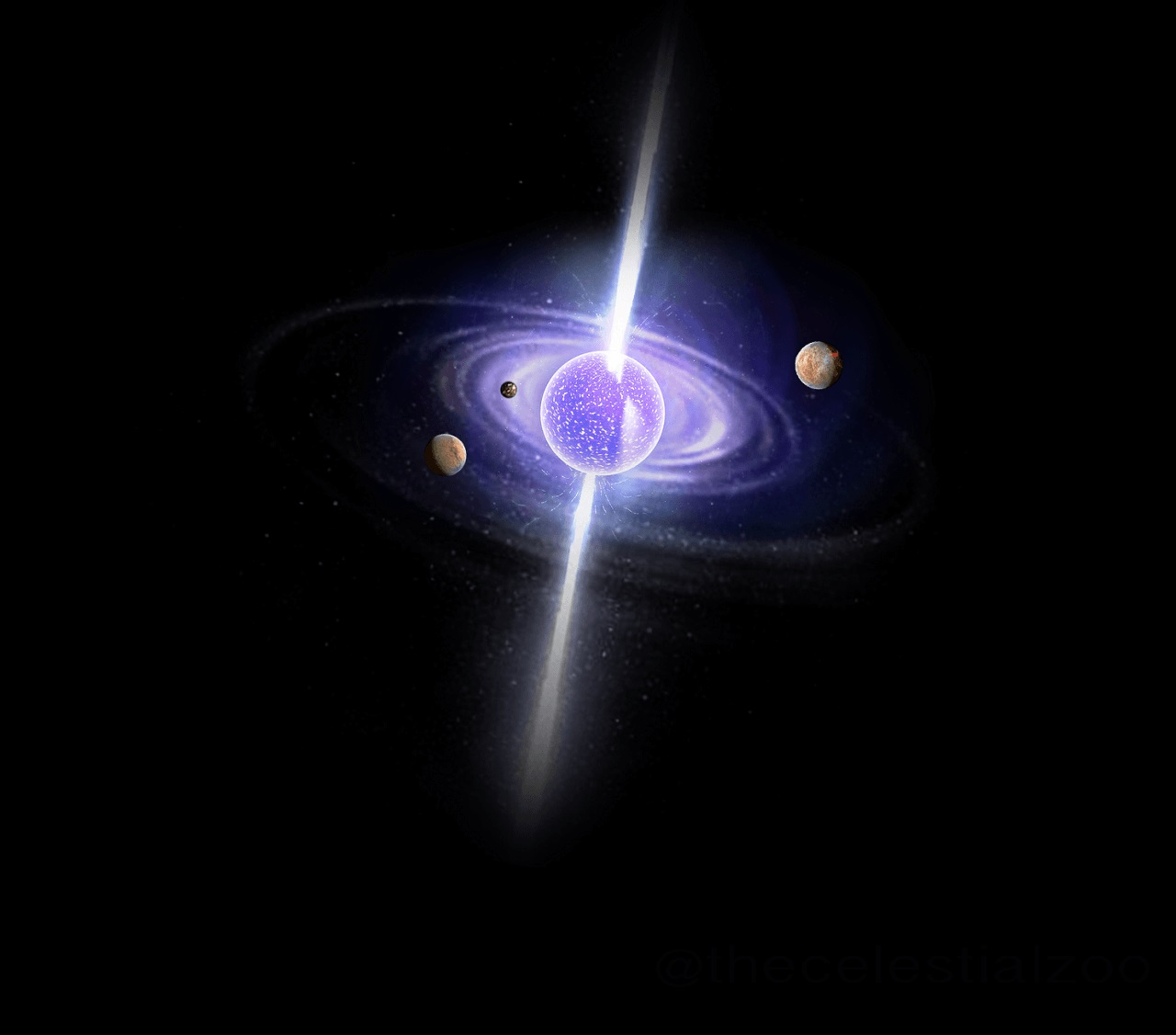
If it is a neutron star, it may be the heaviest yet discovered. But if it is a black hole, it will be the lightest one we know of.
It has 2.09 – 2.71 solar masses, and with this indicator, it is at the bottom of the lower limit of the mass of compact objects — this is the range between 2.2 – 5 solar masses, in which only a few neutron stars and black holes have been recorded.
“Any possibility of a companion nature is exciting. The pulsar and black hole system will be an important target for testing theories of gravity, and a heavy neutron star will provide new insights into extremely high-density nuclear physics," says University of Manchester astrophysicist Ben Stoppers.
Neutron stars and black holes are very close relatives. Both are superdense objects and are born from the gravitational collapse of their cores when massive stars die.
The difference is in the mass. A neutron star can be at most 2.3 times more massive than the Sun. Preventing complete collapse is something called degeneracy pressure , in which multiple particles with the same quantum nature cannot occupy the same state, including physical space.

However, in neutron stars the particles are packed as tightly as possible; It is analogous to one large atomic nucleus.
If you add more mass, even the degenerate pressure will not protect them from collapse . Therefore, more massive nuclei should, at least theoretically, completely collapse into a black hole .
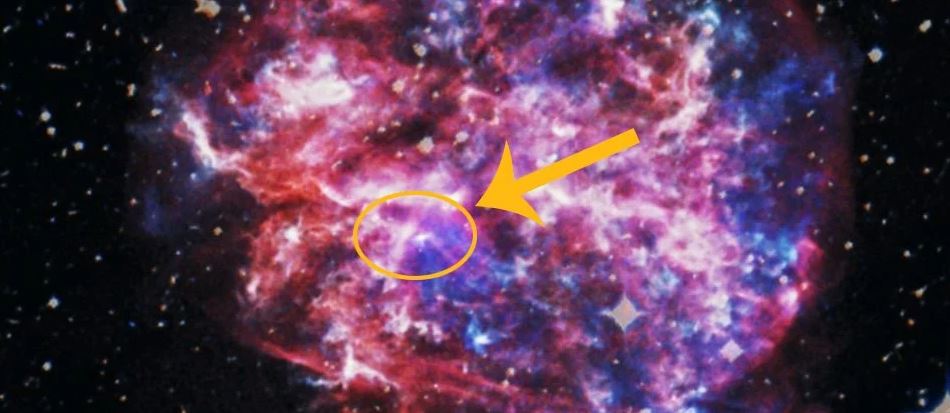
Although the upper limit of neutron star mass is about 2.3 solar masses, very, very few black holes below five solar masses have been discovered so far.
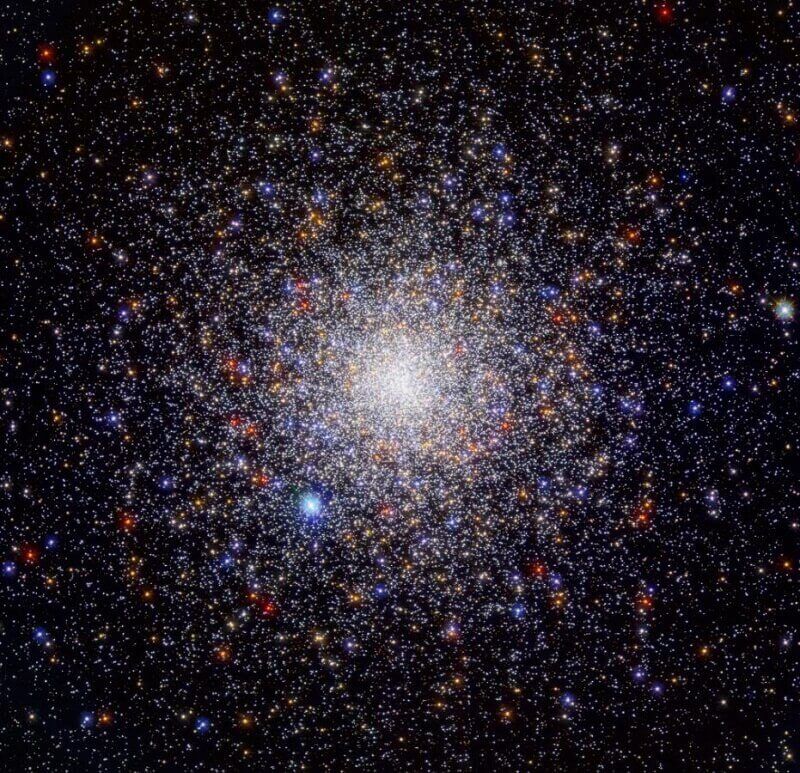
An international team of researchers led by Max Planck Institute for Radio Astronomy astrophysicists Evan Barr and Arunima Dutta discovered the object while studying the strange millisecond pulsar , PSR J0514-4002E; It is located about 54,000 light-years from the galactic center in the star cluster NGC 1851.
In radio data from MEERKat, a collection of radio telescopes in South Africa, they found a strange companion to this pulsar, orbiting it once every 7.44 days; They decided to find out what this object was.
Millisecond pulsars are extremely rapidly rotating neutron stars. As they rotate, they emit radio waves at imprecise time intervals. PSR J0514-4002E rotates 170 times per second. Because its intervals are so imprecise, astronomers can look for even one-point variations in its pulses and use that information to calculate the pulsar's characteristics, its distance from us, and its pair of companions.
Using these interval data from the pulsar, the researchers calculated the distance to PSR J0514-4002E, the mass of the pulsar and its entire system. By subtracting the mass of the pulsar, they also determined the mass of the mysterious object.
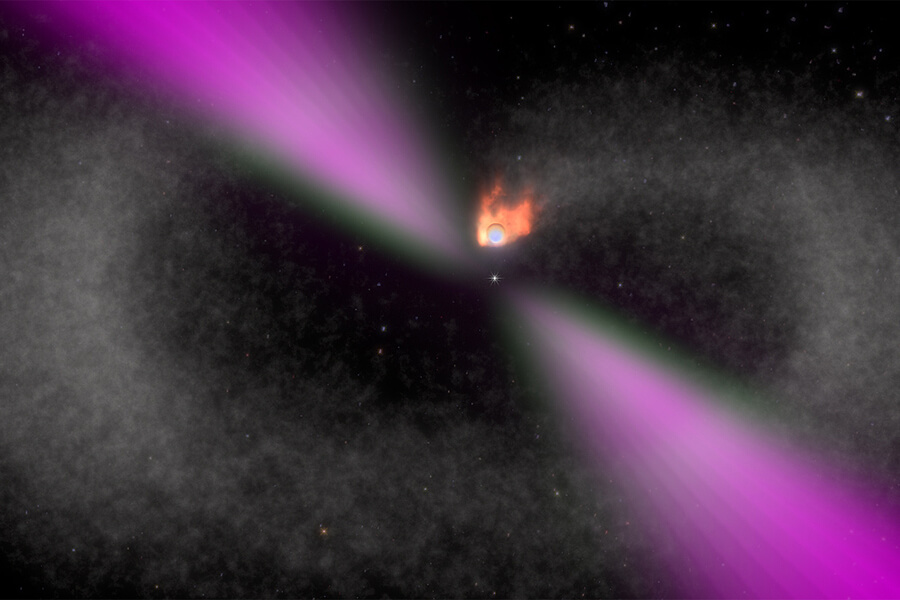
The object is too faint to be a main sequence star, and too massive to be a white dwarf star. Only two possibilities remain—a neutron star or a black hole.
At this stage, it is impossible to say with certainty which one it is, but according to the researchers, it is the product of the merger of two neutron stars. A few years ago, one such collision was observed through gravitational waves , producing an object with 2.6 solar masses. The newly discovered object has 2.76 solar masses and is likely to be a large neutron star . If not, only the black hole version remains.
Researchers are actively trying to find out the details.
"We have not completed the research of this system yet. Determining the nature of the companion will be a turning point in our understanding of neutron stars, black holes, and objects in the mass range in between," says Arunima Dutta.
The study was published in the journal Science .
Prepared by eurekalert.org and ScienceAlert.